How to Read a Cricket Scorecard: Complete Guide to Runs, Wickets, Overs & Statistics
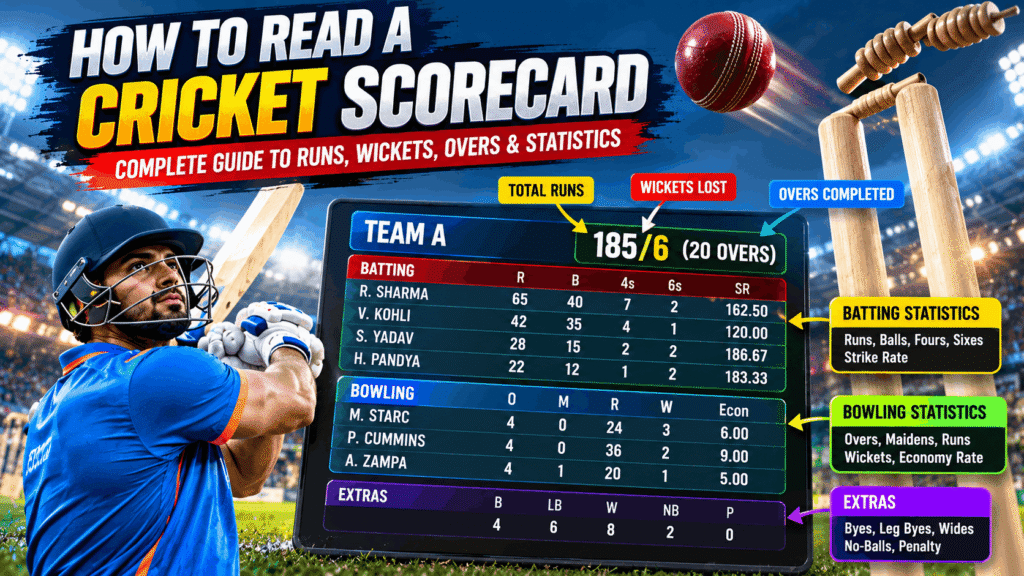
Cricket is a game filled with exciting moments, powerful batting performances, clever bowling strategies, and constantly changing match situations. But understanding the game becomes much easier when you know how to read a cricket scorecard. Whether you’re following an international match, an IPL fixture, a T20 tournament, or a Test series, a cricket scorecard provides essential information about everything happening on the field. For beginners, numbers such as 185/6, 18.4 overs, strike rate, and economy rate can initially seem confusing. However, once you understand these terms, following cricket becomes much more interesting. In this complete guide, we’ll explain how to read cricket scorecards, understand batting and bowling statistics, calculate run rates, and interpret match situations. Readers exploring cricket-related educational content on Cricketbet999 can use this guide to develop a better understanding of cricket statistics and match analysis. What Is a Cricket Scorecard? A cricket scorecard is a structured record of a cricket match that displays important information about both teams and individual players. It helps fans understand the current match situation and review performances after the game has finished. A typical cricket scorecard includes: Modern digital scorecards may also include advanced statistics, graphical analysis, and ball-by-ball commentary. Understanding these details allows cricket fans to interpret matches beyond simply checking which team is winning. Understanding Runs and Wickets in Cricket One of the most important elements of a cricket scorecard is the team’s total score. Consider this example: India: 185/6 (20 overs) This score tells us three important things. First, India scored 185 runs. Second, six wickets were lost during the innings. Third, the innings lasted 20 overs. The same information may sometimes appear as 185–6. What Does 185/6 Mean? The first number represents the runs scored by the batting team. The second number represents the number of wickets lost. For example: Score Meaning 120/2 120 runs, 2 wickets lost 175/5 175 runs, 5 wickets lost 205/8 205 runs, 8 wickets lost 250/10 250 runs, all 10 wickets lost A team’s innings generally ends when ten batters have been dismissed, its allotted overs are completed, or another applicable condition ends the innings. What Are Overs in Cricket? An over normally consists of six legal deliveries bowled by one bowler. After an over is completed, another bowler delivers the next over from the opposite end. Different cricket formats use different innings limits. T20 Cricket Each team normally receives a maximum of 20 overs. This means an innings can contain up to 120 legal deliveries. ODI Cricket Each team normally receives a maximum of 50 overs. This equals 300 legal deliveries. Test Cricket Test cricket does not have a fixed maximum number of overs per innings. Instead, teams compete across multiple sessions over a scheduled period, generally up to five days in men’s international Tests. What Does 18.4 Overs Mean? A scorecard showing 18.4 overs does not mean 18 overs and four-tenths of an over. It means: Therefore, 18.4 overs represents 112 legal deliveries. Understanding this notation is especially important when calculating run rates. Understanding the Batting Scorecard The batting section provides information about each player’s contribution. A standard batting scorecard commonly displays the following columns. Column Meaning Batter Player’s name R Runs scored B Balls faced 4s Number of fours 6s Number of sixes SR Strike rate Consider an example. Batter Runs Balls 4s 6s Strike Rate Player A 65 40 7 2 162.50 Player B 42 35 4 1 120.00 Player C 28 15 2 2 186.67 Player A scored 65 runs from 40 deliveries. Player B contributed 42 runs from 35 deliveries. Player C scored at a particularly fast rate, making 28 runs from 15 balls. These numbers help readers compare different batting performances. What Is Strike Rate in Cricket? Strike rate measures how quickly a batter scores runs. It is particularly important in limited-overs cricket. The batting strike rate formula is: Strike Rate = (Runs Scored ÷ Balls Faced) × 100 Suppose a batter scores 60 runs from 40 balls. Strike Rate = (60 ÷ 40) × 100 = 150 Therefore, the batter’s strike rate is 150. Why Is Strike Rate Important? A higher strike rate indicates faster scoring. However, the ideal strike rate depends on the format, pitch conditions, and match situation. In T20 cricket, aggressive scoring is frequently important. In ODI cricket, batters must balance acceleration with consistency. In Test cricket, scoring rate is often less important than building long innings and protecting wickets. A good cricket analysis evaluates strike rate within the context of the match. Understanding Bowling Statistics The bowling scorecard provides information about the performance of individual bowlers. Common columns include: Column Meaning O Overs bowled M Maiden overs R Runs conceded W Wickets taken Econ Economy rate Consider the following example. Bowler Overs Maidens Runs Wickets Economy Bowler A 4 0 24 3 6.00 Bowler B 4 0 36 2 9.00 Bowler C 4 1 20 1 5.00 Bowler A took three wickets while conceding 24 runs. Bowler B took two wickets but conceded more runs. Bowler C bowled economically and also delivered a maiden over. A bowler’s effectiveness should be evaluated using several statistics rather than wickets alone. What Is Economy Rate in Cricket? Economy rate measures the average number of runs conceded by a bowler per over. The formula is: Economy Rate = Runs Conceded ÷ Overs Bowled For example, suppose a bowler concedes 28 runs in four overs. Economy Rate = 28 ÷ 4 = 7.00 This means the bowler conceded an average of seven runs per over. A lower economy rate generally indicates stronger run control. However, economy rates should be evaluated according to the pitch, format, batting opposition, and match situation. An economy rate of eight may be excellent in one match and expensive in another. What Is Run Rate in Cricket? Run rate measures how quickly a team is scoring. It is calculated by dividing the total runs by the actual number of overs faced. Run Rate = Total Runs ÷ Overs Faced Suppose a team