Cricket Fielding Positions Explained: Names, Roles & Complete Fielding Strategy Guide
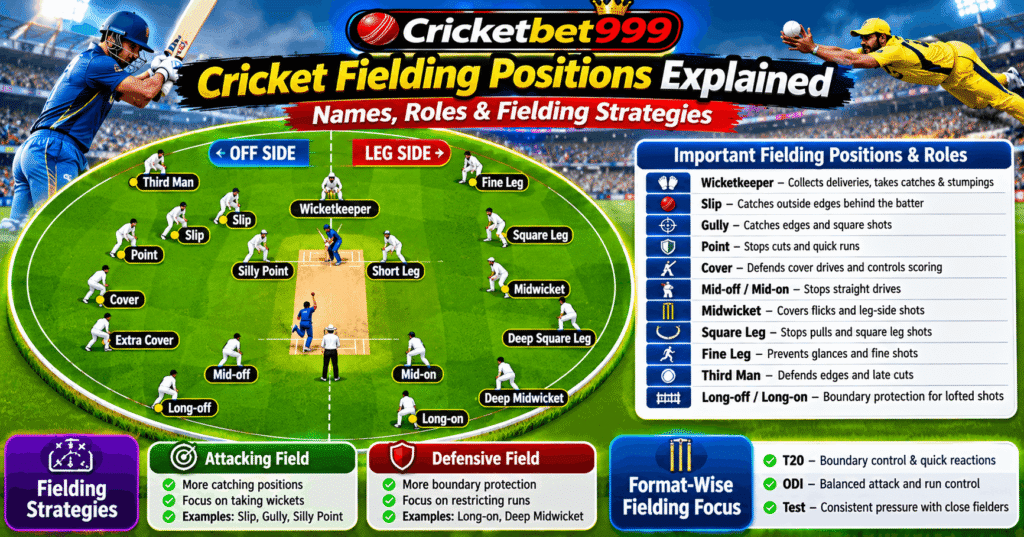
Cricket is not just about powerful batting and accurate bowling. Fielding plays an equally important role in determining the outcome of a match. A perfectly timed boundary can be stopped by an exceptional diving fielder. A difficult catch can change the momentum of an entire innings. Even a single saved run can become important in a closely contested T20 match. However, for beginners, cricket fielding positions can be confusing. Why does a captain place a player at slip? What is the difference between point and cover? Why is a fielder called silly point? And how do field placements change during the powerplay or death overs? Understanding cricket fielding positions is essential for anyone who wants to follow cricket beyond the scoreboard. In this comprehensive guide, we will explore the names of important cricket fielding positions, their locations, tactical purposes, and how captains use different field placements in T20, ODI and Test cricket. Whether you’re a beginner or a cricket enthusiast exploring match analysis on Cricketbet999, this guide will help you understand the tactical decisions behind every fielding arrangement. What Are Cricket Fielding Positions? Cricket fielding positions are named areas around the pitch where fielders stand while the opposing team is batting. The fielding captain decides where players should be positioned, subject to cricket’s laws and the applicable competition rules. Different fielding positions serve different purposes. Some are designed to take catches, while others prevent runs, protect the boundary or create pressure on the batting team. A captain may change field placements depending on the bowler, batter, pitch conditions and match situation. For example, a fast bowler generating movement with the new ball may receive slip fielders to catch edges. A spinner looking for close-in catches may have a short leg or silly point. During the final overs of a T20 match, the captain may prefer more boundary protection. Learning these positions makes it easier to understand why fielders move between deliveries. Understanding the Cricket Field: Off Side and Leg Side Before learning individual fielding positions, it is important to understand the two main sides of the cricket field. What Is the Off Side in Cricket? For a right-handed batter in a conventional batting stance, the off side is the half of the field on the side of the batter’s off stump, generally away from the legs. Several important off-side positions include: The off side is especially important for catching edges, stopping drives and restricting scoring through the covers. What Is the Leg Side in Cricket? The leg side, also called the on side, is the half of the field on the side of the batter’s legs. Important leg-side positions include: These positions are used to defend against flicks, pulls, sweeps and other shots played toward the leg side. Important: The relative off-side and leg-side directions reverse when a left-handed batter faces the bowling. This is why captains frequently adjust field placements when the strike changes between right-handed and left-handed batters. Complete List of Important Cricket Fielding Positions Here is a practical overview of commonly used cricket fielding positions. Fielding Position Side Main Purpose Wicketkeeper Behind batter Collect deliveries, catches and stumpings First Slip Off side Catch outside edges Second Slip Off side Catch edges traveling wider Gully Off side Catch edges and certain cut shots Point Off side Stop square cuts and drives Backward Point Off side Cover shots behind square Cover Off side Stop cover drives Extra Cover Off side Defend the region between cover and mid-off Mid-off Off side Stop straight off-side drives Mid-on Leg side Stop straight on-side drives Midwicket Leg side Defend flicks and drives Square Leg Leg side Cover pulls and shots square of the wicket Fine Leg Leg side Stop glances and fine shots Third Man Off side Protect against edges and late cuts Long-off Off side Defend the straight off-side boundary Long-on Leg side Defend the straight on-side boundary Deep Midwicket Leg side Protect against powerful leg-side hits Deep Square Leg Leg side Protect pulls and sweeps Silly Point Off side Take close catches Short Leg Leg side Take bat-pad and close catches Each position has a particular tactical purpose, although its exact location can vary according to the captain’s plan. 1. Wicketkeeper: The Most Important Position Behind the Stumps The wicketkeeper stands behind the batter’s wicket at the striker’s end. This player has several responsibilities. These include collecting deliveries, taking catches, completing stumpings and helping create run-out opportunities. Wicketkeepers also communicate with bowlers and fielders. An experienced wicketkeeper may help identify changes in the batter’s movement or technique. Why Wicketkeeping Matters A missed catch or stumping can give a batter another opportunity to score. Conversely, a sharp wicketkeeper can create a wicket from a small mistake. Good wicketkeeping requires quick reactions, concentration, footwork and anticipation. 2. Slip Fielding Position Slip is one of the most recognizable catching positions in cricket. Slip fielders stand behind the batter on the off side, alongside the wicketkeeper. Their main responsibility is to catch balls that take an outside edge from the bat. When Are Slips Used? Slip fielders are commonly used when: In Test cricket, captains may place multiple fielders in the slip cordon. However, limited-overs captains may use fewer slips when preventing runs becomes the priority. 3. Gully Fielding Position Gully is located on the off side, generally wider and more square than the slip cordon. The position is designed to catch certain edges and poorly controlled shots. A gully fielder requires excellent reactions because the ball can travel quickly. Slip vs Gully: What’s the Difference? Slip fielders generally wait for edges that travel behind the batter. Gully fielders cover a wider region, catching edges that travel more square of the wicket. Both positions can be particularly useful during aggressive fast bowling spells. 4. Point and Backward Point Point is positioned approximately square of the wicket on the off side. This area is frequently targeted by batters playing cut shots. A point fielder may be expected to stop powerful shots and prevent easy singles.