cricketbets999

Cricket Fielding Positions
cricket, Cricket id, cricket news, cricketbet999, cricketbets999

Cricket Fielding Positions Explained: Names, Roles & Complete Fielding Strategy Guide

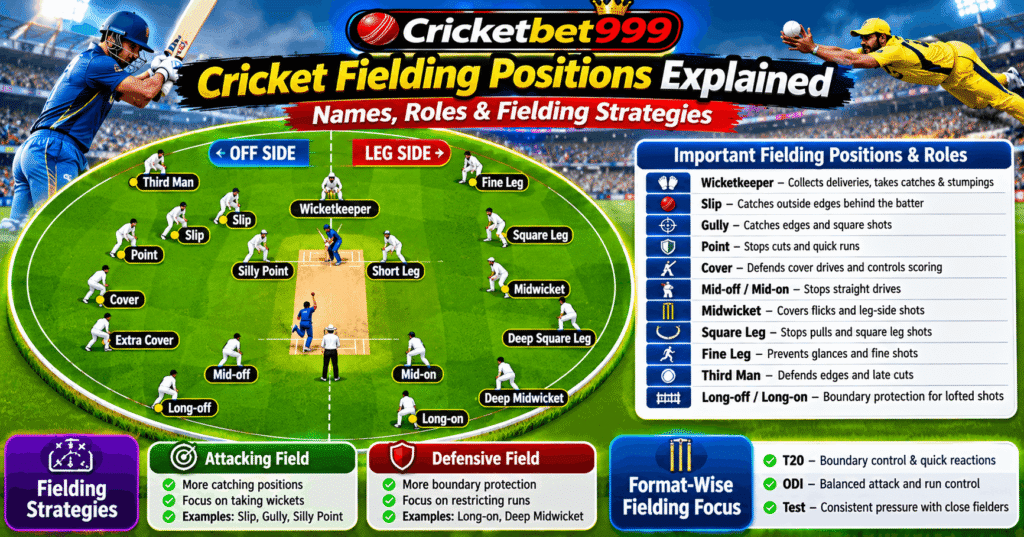
Cricket is not just about powerful batting and accurate bowling. Fielding plays an equally important role in determining the outcome of a match. A perfectly timed boundary can be stopped by an exceptional diving fielder. A difficult catch can change the momentum of an entire innings. Even a single saved run can become important in a closely contested T20 match. However, for beginners, cricket fielding positions can be confusing. Why does a captain place a player at slip? What is the difference between point and cover? Why is a fielder called silly point? And how do field placements change during the powerplay or death overs? Understanding cricket fielding positions is essential for anyone who wants to follow cricket beyond the scoreboard. In this comprehensive guide, we will explore the names of important cricket fielding positions, their locations, tactical purposes, and how captains use different field placements in T20, ODI and Test cricket. Whether you’re a beginner or a cricket enthusiast exploring match analysis on Cricketbet999, this guide will help you understand the tactical decisions behind every fielding arrangement. What Are Cricket Fielding Positions? Cricket fielding positions are named areas around the pitch where fielders stand while the opposing team is batting. The fielding captain decides where players should be positioned, subject to cricket’s laws and the applicable competition rules. Different fielding positions serve different purposes. Some are designed to take catches, while others prevent runs, protect the boundary or create pressure on the batting team. A captain may change field placements depending on the bowler, batter, pitch conditions and match situation. For example, a fast bowler generating movement with the new ball may receive slip fielders to catch edges. A spinner looking for close-in catches may have a short leg or silly point. During the final overs of a T20 match, the captain may prefer more boundary protection. Learning these positions makes it easier to understand why fielders move between deliveries. Understanding the Cricket Field: Off Side and Leg Side Before learning individual fielding positions, it is important to understand the two main sides of the cricket field. What Is the Off Side in Cricket? For a right-handed batter in a conventional batting stance, the off side is the half of the field on the side of the batter’s off stump, generally away from the legs. Several important off-side positions include: The off side is especially important for catching edges, stopping drives and restricting scoring through the covers. What Is the Leg Side in Cricket? The leg side, also called the on side, is the half of the field on the side of the batter’s legs. Important leg-side positions include: These positions are used to defend against flicks, pulls, sweeps and other shots played toward the leg side. Important: The relative off-side and leg-side directions reverse when a left-handed batter faces the bowling. This is why captains frequently adjust field placements when the strike changes between right-handed and left-handed batters. Complete List of Important Cricket Fielding Positions Here is a practical overview of commonly used cricket fielding positions. Fielding Position Side Main Purpose Wicketkeeper Behind batter Collect deliveries, catches and stumpings First Slip Off side Catch outside edges Second Slip Off side Catch edges traveling wider Gully Off side Catch edges and certain cut shots Point Off side Stop square cuts and drives Backward Point Off side Cover shots behind square Cover Off side Stop cover drives Extra Cover Off side Defend the region between cover and mid-off Mid-off Off side Stop straight off-side drives Mid-on Leg side Stop straight on-side drives Midwicket Leg side Defend flicks and drives Square Leg Leg side Cover pulls and shots square of the wicket Fine Leg Leg side Stop glances and fine shots Third Man Off side Protect against edges and late cuts Long-off Off side Defend the straight off-side boundary Long-on Leg side Defend the straight on-side boundary Deep Midwicket Leg side Protect against powerful leg-side hits Deep Square Leg Leg side Protect pulls and sweeps Silly Point Off side Take close catches Short Leg Leg side Take bat-pad and close catches Each position has a particular tactical purpose, although its exact location can vary according to the captain’s plan. 1. Wicketkeeper: The Most Important Position Behind the Stumps The wicketkeeper stands behind the batter’s wicket at the striker’s end. This player has several responsibilities. These include collecting deliveries, taking catches, completing stumpings and helping create run-out opportunities. Wicketkeepers also communicate with bowlers and fielders. An experienced wicketkeeper may help identify changes in the batter’s movement or technique. Why Wicketkeeping Matters A missed catch or stumping can give a batter another opportunity to score. Conversely, a sharp wicketkeeper can create a wicket from a small mistake. Good wicketkeeping requires quick reactions, concentration, footwork and anticipation. 2. Slip Fielding Position Slip is one of the most recognizable catching positions in cricket. Slip fielders stand behind the batter on the off side, alongside the wicketkeeper. Their main responsibility is to catch balls that take an outside edge from the bat. When Are Slips Used? Slip fielders are commonly used when: In Test cricket, captains may place multiple fielders in the slip cordon. However, limited-overs captains may use fewer slips when preventing runs becomes the priority. 3. Gully Fielding Position Gully is located on the off side, generally wider and more square than the slip cordon. The position is designed to catch certain edges and poorly controlled shots. A gully fielder requires excellent reactions because the ball can travel quickly. Slip vs Gully: What’s the Difference? Slip fielders generally wait for edges that travel behind the batter. Gully fielders cover a wider region, catching edges that travel more square of the wicket. Both positions can be particularly useful during aggressive fast bowling spells. 4. Point and Backward Point Point is positioned approximately square of the wicket on the off side. This area is frequently targeted by batters playing cut shots. A point fielder may be expected to stop powerful shots and prevent easy singles.

DLS Method in Cricket: Rules & Examples
cricket, Cricket id, cricket news, cricketbet999, cricketbets999

DLS Method in Cricket Explained: Rain Rules, Revised Targets, Calculations & Complete Guide

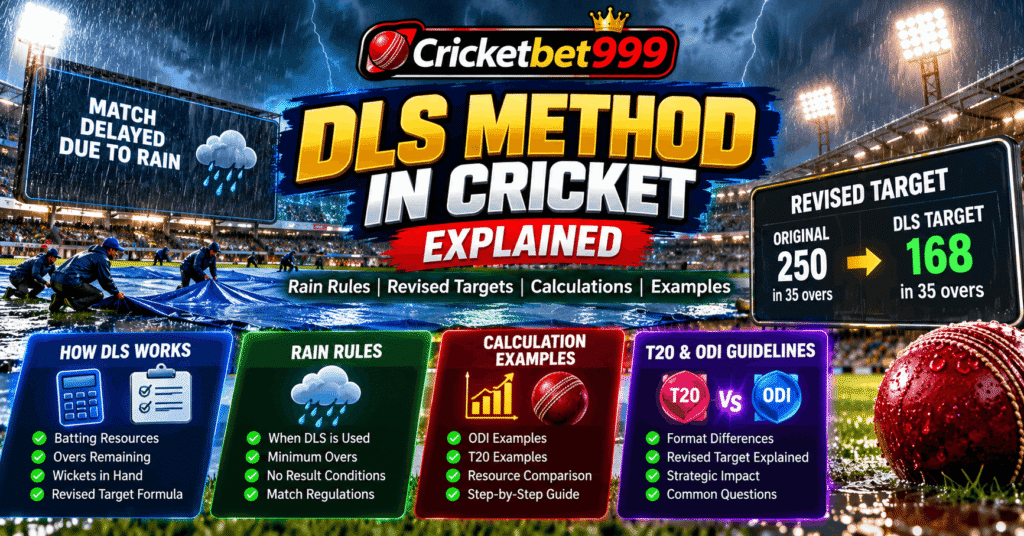
Imagine watching an exciting T20 cricket match. The batting team scores a competitive total, and the chasing side begins its innings with confidence. Suddenly, dark clouds cover the stadium, rain begins to fall, and play is suspended. When the match finally resumes, the scoreboard displays a completely different target. Fans immediately start asking questions. Why has the target changed? How did the umpires calculate the new score? Does the chasing team now have an advantage? The answer is the DLS Method in Cricket, one of the most important systems used to manage rain-affected limited-overs matches. The Duckworth–Lewis–Stern method helps determine revised targets when a cricket match loses playing time because of rain or other interruptions. However, DLS is more complicated than simply reducing the original target according to the number of overs lost. It considers the batting resources available to each team, particularly overs remaining and wickets lost. In this complete guide, we’ll explain how the DLS method works, why it is important, how revised targets are determined, and what cricket fans should understand when following interrupted matches. Whether you’re learning about cricket statistics or exploring educational guides on Cricketbet999, understanding DLS can help you interpret match results more confidently. What Is the DLS Method in Cricket? DLS stands for Duckworth–Lewis–Stern. It is a mathematical method used to adjust targets and determine results in interrupted limited-overs cricket matches. The method is primarily associated with One Day Internationals (ODIs) and Twenty20 cricket. Its main purpose is to make a revised chase as fair as possible when one or both teams lose batting opportunities. For example, suppose Team A completes its full innings, but rain reduces the number of overs available to Team B. It would not usually be fair to expect Team B to chase the original target with significantly fewer deliveries. However, simply reducing the target in direct proportion to the overs lost can also be unfair. The DLS method addresses this problem by considering how many batting resources each team has available. Why Is the DLS Method Important? Weather interruptions are common in cricket, particularly in countries where rainfall and changing conditions can affect matches. Without a systematic method for adjusting targets, shortened matches could become unbalanced. Consider a simple situation. Team A scores 250 runs in 50 overs. Team B is originally scheduled to receive 50 overs but is later restricted to 30 overs because of rain. A simple calculation might suggest reducing the target in the same proportion as the overs. However, that approach ignores an important factor: Team B still starts its innings with ten wickets available. A team that knows it has only 30 overs may adopt a more aggressive approach than one planning to bat for 50 overs. DLS attempts to account for such differences. The system helps officials establish revised targets using a consistent statistical method. Who Invented the Duckworth–Lewis–Stern Method? The original Duckworth–Lewis method was developed by two statisticians: Frank Duckworth and Tony Lewis. Their work introduced a more systematic way to adjust limited-overs cricket targets after interruptions. The method was later refined by Steven Stern, whose contribution led to the name Duckworth–Lewis–Stern. The updated system became known as DLS. Over time, it has become an important part of international limited-overs cricket. The International Cricket Council recognizes DLS as the method used for recalculating targets under applicable playing conditions. How Does the DLS Method Work? The central concept behind DLS is run-scoring resources. A batting team has two important resources available during its innings: The more overs and wickets a team has available, the greater its potential opportunity to score runs. As a match progresses, these resources are gradually used. When rain reduces the available overs, a team loses part of its remaining resources without necessarily losing any wickets. DLS evaluates this reduction and adjusts the target accordingly. Understanding Batting Resources Consider these hypothetical match situations. Match Situation Overs Remaining Wickets in Hand Situation A 20 10 Situation B 10 10 Situation C 10 4 Situation D 5 2 Situation A provides the greatest opportunity to score because the team has more deliveries and all its wickets available. Situation D offers significantly fewer batting resources. The official DLS calculation assigns resource percentages to combinations of overs remaining and wickets lost. These percentages are used to determine how an interruption changes the balance between the two teams. DLS Method Calculation: A Simple Example Let’s examine a simplified example. Suppose Team A scores 200 runs in a completed innings. Rain then reduces the batting resources available to Team B. For illustration, assume the applicable DLS resource calculations show: A simplified target calculation would be: Revised Target = Team A Score × (Team B Resources ÷ Team A Resources) + 1 Therefore: 200 × (75 ÷ 100) + 1 = 151 runs. The revised target would be 151 runs under these illustrative assumptions. This example demonstrates the basic principle. Important: The 75% resource figure is hypothetical. Actual DLS calculations depend on official resource values, match circumstances, and the applicable DLS edition. Professional calculations may be more complex than this simplified example. Why DLS Is Not the Same as Run Rate One of the most common misunderstandings among cricket fans is that DLS simply uses run rate to adjust a target. This is incorrect. Run rate measures how quickly a team scores runs. For example: Run Rate = Runs Scored ÷ Overs Faced If a team scores 100 runs in 10 overs, its run rate is 10.00. DLS, however, also considers the batting resources available when the match is interrupted. This includes wickets already lost and overs remaining. Two teams with the same score and run rate may receive different DLS assessments if their wicket situations differ. That distinction is central to understanding the method. How Does DLS Work in T20 Cricket? T20 cricket is especially sensitive to rain interruptions because the original innings contains only 20 overs. Losing even a few overs can significantly affect the batting team’s strategy. Example: T20 Match Interrupted by

T20 Cricket Strategy: Powerplay to Death Overs
cricket, Cricket id, cricket news, cricketbet999, cricketbets999, Earn Money, Indian Cricket

T20 Cricket Strategy Explained: Powerplay, Middle Overs, Death Overs & Complete Match Analysis Guide

A T20 cricket match can change completely in just six deliveries. One explosive over can put the batting team in control, while two quick wickets can suddenly bring the bowling side back into the contest. But what really decides a T20 match? Is it aggressive batting, accurate bowling, smart captaincy, or the ability to handle pressure? The answer is usually a combination of all these factors. T20 cricket strategy involves much more than hitting sixes and taking wickets. Successful teams need to plan their powerplay, control the middle overs, execute their death-over strategies, and adapt to different pitch conditions. A team may have some of the world’s best batters and bowlers, yet struggle if it fails to make the right tactical decisions. For cricket enthusiasts who enjoy match previews, statistical analysis, and educational cricket content, understanding these strategies makes every game more interesting. In this comprehensive guide, we’ll explore how T20 teams approach different match situations, what statistics matter most, and how fans can analyze a game more effectively. What Is T20 Cricket Strategy? T20 cricket strategy refers to the tactical decisions teams make to maximize their chances of winning a 20-over match. Unlike Test cricket, teams have limited deliveries available to build an innings or defend a total. Every over can influence the result. A successful T20 strategy generally involves: The best teams do not follow a single fixed strategy. Instead, they adapt their approach according to available players, opposition strengths, and playing conditions. Understanding the Three Important Phases of T20 Cricket A standard T20 innings contains 20 overs, which can be divided into three tactical phases. Phase Overs Main Strategic Focus Powerplay 1–6 Early scoring and wicket-taking Middle Overs 7–15 Partnerships, run control and matchups Death Overs 16–20 Finishing, variations and pressure Each stage requires a different approach. An aggressive opening partnership may create a strong foundation, but poor execution during the death overs can still prevent a team from reaching a competitive total. Similarly, a bowling team that struggles early can recover through disciplined middle-over bowling and an effective finish. Let’s examine each phase in detail. 1. T20 Powerplay Strategy: Why the First Six Overs Matter The powerplay is one of the most important phases of a T20 innings. In a standard men’s T20 International, only two fielders are permitted outside the 30-yard fielding restriction area during the first six overs. This creates opportunities for batters to find boundaries. At the same time, fast bowlers often have the opportunity to use the new ball to create early breakthroughs. Powerplay Batting Strategy Opening batters generally try to score quickly without taking unnecessary risks. Their objective is to make effective use of fielding restrictions while building a solid start. Important batting strategies include: Attacking loose deliveries: Batters look to punish short, wide, or overpitched bowling. Finding gaps: Placement can be just as valuable as power when fewer fielders are positioned near the boundary. Rotating the strike: Singles and twos help maintain the scoring rate when boundaries are difficult to find. Building partnerships: A strong opening partnership provides stability for the middle order. Example: Comparing Two Powerplay Performances Consider two hypothetical teams. Team Powerplay Score Wickets Lost Team A 62/1 1 Team B 48/0 0 Team A has scored more runs but lost one wicket. Team B has preserved its entire opening partnership while scoring at a slightly slower rate. Which team has performed better? There is no automatic answer. The situation depends on pitch conditions, batting depth, target score, and the quality of the remaining bowlers. Team A may benefit from its higher scoring rate, while Team B may be better positioned to accelerate later. This is why meaningful T20 analysis requires more than looking at the scoreboard. 2. Powerplay Bowling Strategy: Taking Early Wickets For the bowling team, the powerplay is an opportunity to disrupt the opposition’s batting plans. Early wickets can force the batting side into a more cautious approach. Fast bowlers often attempt to exploit swing, seam movement, or bounce with the new ball. Effective Powerplay Bowling Tactics Accurate line and length: Bowling consistently in challenging areas can restrict scoring opportunities. Swing and seam movement: Movement in the air or off the pitch can create difficulties for opening batters. Attacking field placements: Captains may use slip fielders when conditions favor early wickets. Variation in pace: Changes of pace may disrupt batters who are attempting aggressive shots. Why Early Wickets Matter Imagine a team scores 55 runs during the first six overs but loses four wickets. Although its run rate is reasonably high, the middle order now faces greater pressure. Losing several early wickets may prevent the team from accelerating during the final overs. This demonstrates why wickets remaining are an important part of match analysis. 3. Middle Overs Strategy: The Most Underrated Phase of T20 Cricket Overs 7–15 are often described as the middle overs. This period is strategically important because teams must balance scoring with wicket preservation. The batting side aims to maintain momentum, while the bowling side attempts to restrict runs and create pressure. Middle-Overs Batting Strategy A successful middle-order partnership can determine whether a team reaches a competitive total. Common strategies include: The ideal approach varies according to the score and conditions. Example: Middle-Overs Match Situation Suppose Team A finishes the powerplay at 58/1. After 15 overs, its score is 132/3. The team has added 74 runs in nine overs while losing two wickets. With seven wickets remaining and five overs left, the batting side may be well positioned to increase its scoring rate. However, the quality of the remaining bowling attack and the pitch conditions will influence what total is achievable. 4. The Role of Spin Bowling During Middle Overs Spin bowling is an important tactical weapon in T20 cricket. Captains often introduce spin bowlers during the middle overs to reduce scoring opportunities and create wickets. Spin bowlers use flight, turn, pace variation, and changes in trajectory to challenge batters. Why Spin Can Be Effective Changes in pace: Slower deliveries can

How to Read a Cricket Scorecard: Complete Guide
cricket, Cricket id, cricket news, cricketbet999, cricketbets999, live cricket, live cricket score

How to Read a Cricket Scorecard: Complete Guide to Runs, Wickets, Overs & Statistics

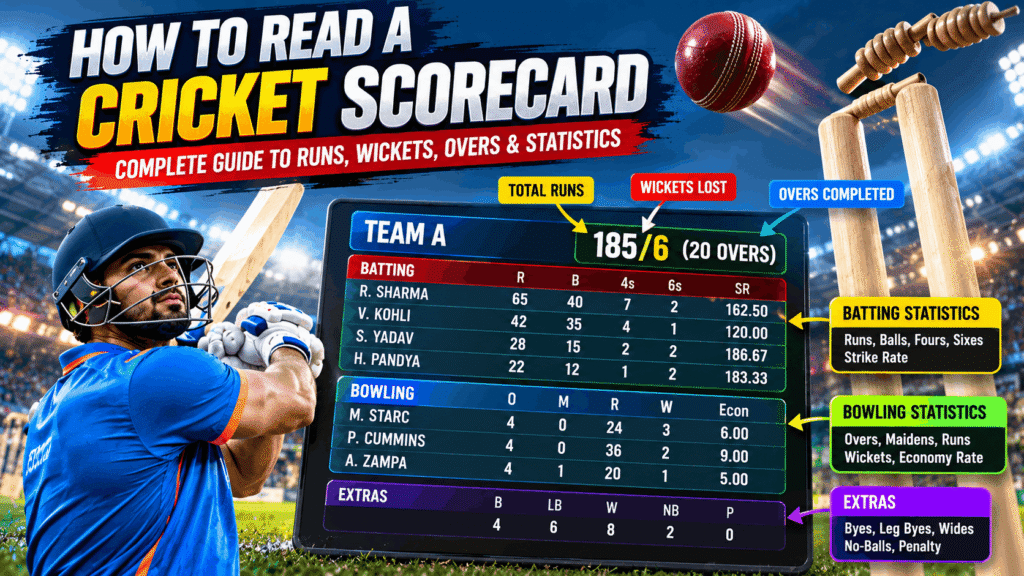
Cricket is a game filled with exciting moments, powerful batting performances, clever bowling strategies, and constantly changing match situations. But understanding the game becomes much easier when you know how to read a cricket scorecard. Whether you’re following an international match, an IPL fixture, a T20 tournament, or a Test series, a cricket scorecard provides essential information about everything happening on the field. For beginners, numbers such as 185/6, 18.4 overs, strike rate, and economy rate can initially seem confusing. However, once you understand these terms, following cricket becomes much more interesting. In this complete guide, we’ll explain how to read cricket scorecards, understand batting and bowling statistics, calculate run rates, and interpret match situations. Readers exploring cricket-related educational content on Cricketbet999 can use this guide to develop a better understanding of cricket statistics and match analysis. What Is a Cricket Scorecard? A cricket scorecard is a structured record of a cricket match that displays important information about both teams and individual players. It helps fans understand the current match situation and review performances after the game has finished. A typical cricket scorecard includes: Modern digital scorecards may also include advanced statistics, graphical analysis, and ball-by-ball commentary. Understanding these details allows cricket fans to interpret matches beyond simply checking which team is winning. Understanding Runs and Wickets in Cricket One of the most important elements of a cricket scorecard is the team’s total score. Consider this example: India: 185/6 (20 overs) This score tells us three important things. First, India scored 185 runs. Second, six wickets were lost during the innings. Third, the innings lasted 20 overs. The same information may sometimes appear as 185–6. What Does 185/6 Mean? The first number represents the runs scored by the batting team. The second number represents the number of wickets lost. For example: Score Meaning 120/2 120 runs, 2 wickets lost 175/5 175 runs, 5 wickets lost 205/8 205 runs, 8 wickets lost 250/10 250 runs, all 10 wickets lost A team’s innings generally ends when ten batters have been dismissed, its allotted overs are completed, or another applicable condition ends the innings. What Are Overs in Cricket? An over normally consists of six legal deliveries bowled by one bowler. After an over is completed, another bowler delivers the next over from the opposite end. Different cricket formats use different innings limits. T20 Cricket Each team normally receives a maximum of 20 overs. This means an innings can contain up to 120 legal deliveries. ODI Cricket Each team normally receives a maximum of 50 overs. This equals 300 legal deliveries. Test Cricket Test cricket does not have a fixed maximum number of overs per innings. Instead, teams compete across multiple sessions over a scheduled period, generally up to five days in men’s international Tests. What Does 18.4 Overs Mean? A scorecard showing 18.4 overs does not mean 18 overs and four-tenths of an over. It means: Therefore, 18.4 overs represents 112 legal deliveries. Understanding this notation is especially important when calculating run rates. Understanding the Batting Scorecard The batting section provides information about each player’s contribution. A standard batting scorecard commonly displays the following columns. Column Meaning Batter Player’s name R Runs scored B Balls faced 4s Number of fours 6s Number of sixes SR Strike rate Consider an example. Batter Runs Balls 4s 6s Strike Rate Player A 65 40 7 2 162.50 Player B 42 35 4 1 120.00 Player C 28 15 2 2 186.67 Player A scored 65 runs from 40 deliveries. Player B contributed 42 runs from 35 deliveries. Player C scored at a particularly fast rate, making 28 runs from 15 balls. These numbers help readers compare different batting performances. What Is Strike Rate in Cricket? Strike rate measures how quickly a batter scores runs. It is particularly important in limited-overs cricket. The batting strike rate formula is: Strike Rate = (Runs Scored ÷ Balls Faced) × 100 Suppose a batter scores 60 runs from 40 balls. Strike Rate = (60 ÷ 40) × 100 = 150 Therefore, the batter’s strike rate is 150. Why Is Strike Rate Important? A higher strike rate indicates faster scoring. However, the ideal strike rate depends on the format, pitch conditions, and match situation. In T20 cricket, aggressive scoring is frequently important. In ODI cricket, batters must balance acceleration with consistency. In Test cricket, scoring rate is often less important than building long innings and protecting wickets. A good cricket analysis evaluates strike rate within the context of the match. Understanding Bowling Statistics The bowling scorecard provides information about the performance of individual bowlers. Common columns include: Column Meaning O Overs bowled M Maiden overs R Runs conceded W Wickets taken Econ Economy rate Consider the following example. Bowler Overs Maidens Runs Wickets Economy Bowler A 4 0 24 3 6.00 Bowler B 4 0 36 2 9.00 Bowler C 4 1 20 1 5.00 Bowler A took three wickets while conceding 24 runs. Bowler B took two wickets but conceded more runs. Bowler C bowled economically and also delivered a maiden over. A bowler’s effectiveness should be evaluated using several statistics rather than wickets alone. What Is Economy Rate in Cricket? Economy rate measures the average number of runs conceded by a bowler per over. The formula is: Economy Rate = Runs Conceded ÷ Overs Bowled For example, suppose a bowler concedes 28 runs in four overs. Economy Rate = 28 ÷ 4 = 7.00 This means the bowler conceded an average of seven runs per over. A lower economy rate generally indicates stronger run control. However, economy rates should be evaluated according to the pitch, format, batting opposition, and match situation. An economy rate of eight may be excellent in one match and expensive in another. What Is Run Rate in Cricket? Run rate measures how quickly a team is scoring. It is calculated by dividing the total runs by the actual number of overs faced. Run Rate = Total Runs ÷ Overs Faced Suppose a team

T20 vs ODI vs Test Cricket
cricket, Cricket id, cricket news, cricketbet999, cricketbets999

T20 vs ODI vs Test Cricket Explained: Rules, Overs, Strategies & Key Differences

Cricket is one of the most fascinating sports in the world, loved by millions of fans for its combination of skill, strategy, teamwork, and unforgettable moments. However, if you’re new to cricket, you might wonder why some matches finish in just a few hours while others continue for five days. The answer lies in the different formats of cricket. At the international level, cricket is primarily played in three formats: Twenty20 (T20), One Day International (ODI), and Test cricket. Although all three formats follow the same fundamental principles, they differ significantly in match duration, overs, batting approach, bowling strategies, and tactical decision-making. Whether you’re following international fixtures, exploring match previews, or learning about cricket through Cricketbet999, understanding these differences can make watching the game much more enjoyable. In this detailed guide, we’ll explain everything you need to know about T20 vs ODI vs Test cricket, including their rules, major differences, strategies, and frequently asked questions. What Are the Three Main Formats of Cricket? Cricket has evolved significantly since international Test cricket began in 1877. Today, international cricket features three major formats, each offering a different viewing experience. 1. T20 Cricket – The Fastest Format Twenty20 cricket is a short, action-packed format where each team normally receives a maximum of 20 overs. With only 120 legal deliveries available per innings, batters often adopt aggressive strategies to score quickly. T20 matches typically last around three hours, although actual duration can vary. The format is known for explosive batting, innovative bowling variations, athletic fielding, and exciting finishes. 2. ODI Cricket – The Balanced Format One Day International cricket is played with a maximum of 50 overs per team. It combines the attacking nature of limited-overs cricket with the need to build partnerships and manage an innings carefully. ODI cricket requires teams to balance aggressive scoring with wicket preservation. A standard ODI generally takes around seven to eight hours, including the innings interval, although delays can extend its duration. 3. Test Cricket – The Traditional Format Test cricket is the longest traditional international format. A standard men’s Test match is scheduled for up to five days, with each team normally having the opportunity to bat twice. Unlike T20 and ODI cricket, Test cricket does not impose a fixed maximum number of overs on an innings. Success requires patience, concentration, technical skill, physical endurance, and the ability to adapt to changing pitch conditions. T20 vs ODI vs Test Cricket: Complete Comparison Table Understanding the major differences becomes easier when the three formats are compared side by side. Feature T20 Cricket ODI Cricket Test Cricket Maximum Overs 20 per team 50 per team No fixed innings limit Innings 1 per team 1 per team Up to 2 per team Match Duration Around 3 hours Around 7–8 hours Up to 5 days Playing Style Highly aggressive Balanced Strategic and patient Ball Colour White White Red or pink Powerplay First 6 overs Multiple phases No limited-overs powerplay Clothing Coloured kits Coloured kits Traditionally white Result Possibilities Win, tie, no result Win, tie, no result Win, loss, draw, tie Major Competition ICC T20 World Cup ICC Cricket World Cup ICC World Test Championship Actual rules may vary according to competition regulations, weather interruptions, and updated playing conditions. Understanding T20 Cricket in Detail T20 cricket has transformed the way modern cricket is played. The format became popular because it offers fast-paced entertainment and fits into a relatively short time window. Each team has a maximum of 20 overs to score as many runs as possible. The opposing team then attempts to chase the target. How Does a T20 Match Work? A standard T20 match follows a straightforward structure: If scores are tied, a Super Over or another competition-specific procedure may determine the winner. Why Is T20 Cricket So Popular? T20 cricket offers several attractions. Fast-paced action: Batters frequently attempt attacking shots and boundaries. Shorter duration: Matches can usually be completed within a few hours. Unpredictable momentum: A few wickets or boundaries can dramatically change the match. Exciting final overs: Close finishes often create memorable moments. Innovative strategies: Bowlers use variations, while batters develop creative scoring techniques. T20 Batting Strategies In T20 cricket, batters often prioritize strike rate. A batter scoring 40 runs from 20 deliveries can make an important contribution because the team has limited overs. Opening batters frequently attempt to use the powerplay effectively. Middle-order players must balance scoring quickly with maintaining partnerships. Finishers are especially important during the final overs. T20 Bowling Strategies Bowlers face the challenge of restricting aggressive batters. Common strategies include: Strong execution can make a difference even on batting-friendly pitches. Understanding ODI Cricket in Detail One Day International cricket offers a unique balance between attacking play and longer-term strategy. Each team normally receives 50 overs. Unlike T20 cricket, batters have more time to build an innings, recover from early wickets, and establish partnerships. However, teams must still maintain a competitive scoring rate. How Does an ODI Match Work? A standard ODI follows these stages: First innings: One team bats for up to 50 overs. Innings interval: Teams prepare for the second half of the match. Second innings: The chasing team attempts to reach the target within its allotted overs. The result depends on the runs scored, wickets lost, and applicable match regulations. Why Is ODI Cricket Different from T20? ODI cricket allows teams to recover from difficult situations. For example, a team losing three wickets during the first ten overs may still build a competitive total through middle-order partnerships. In T20 cricket, recovering from a similar situation can be more difficult because fewer overs remain. This makes ODI cricket particularly interesting for fans who enjoy both aggressive batting and tactical planning. ODI Batting Strategy ODI batting often involves three broad stages. Opening overs: Batters establish a foundation and take advantage of fielding restrictions. Middle overs: Teams build partnerships, rotate the strike, and maintain scoring momentum. Final overs: Batters often increase aggression and attempt to maximize the total. Successful ODI teams adjust their approach

India vs New Zealand 2026: Full Schedule, Squads, T20I, ODI & Test Series
BCCI News, cricket, Cricket id, cricket news, cricketbet999, cricketbets999, Indian Cricket, live cricket, live cricket score, live score

India vs New Zealand 2026: Full Series Schedule, T20I, ODI & Test Matches, Squads, Key Players and Complete Cricket Guide

The India vs New Zealand 2026 series is one of the most exciting international cricket contests of the season. Two highly competitive teams are set to face each other across three different formats in a major tour that will test batting strength, bowling quality, tactical planning, and the ability to perform under pressure. India’s tour of New Zealand begins on 22 October 2026 and continues until 1 December 2026, featuring a total of 12 international matches: five T20 Internationals, five One Day Internationals, and two Test matches. For cricket enthusiasts, this series offers everything from explosive T20 batting to strategic ODI contests and traditional five-day Test cricket. Whether you are looking for the India vs New Zealand 2026 schedule, squad information, pitch conditions, team comparisons, or upcoming match previews, this complete guide brings everything together. Readers exploring cricket information on Cricketbet999 can use this article as a central reference throughout the entire tour. India vs New Zealand 2026 Series Overview India and New Zealand share a competitive cricketing history across all three formats. New Zealand’s home conditions can present unique challenges for visiting teams, especially when pitches offer bounce, seam movement, or changing weather conditions. India, meanwhile, brings considerable batting talent, varied bowling options, and experience competing against leading international teams. The combination makes this multi-format tour an interesting contest for cricket followers. IND vs NZ 2026: Key Series Details Details Information Series India Tour of New Zealand 2026 Starting Date 22 October 2026 Ending Date 1 December 2026 Host Country New Zealand Total Matches 12 T20 Internationals 5 One Day Internationals 5 Test Matches 2 Participating Teams India and New Zealand Match Venues Christchurch, Wellington, Auckland, Hamilton and Tauranga The tour begins with T20 cricket, transitions into the 50-over format, and concludes with a two-match Test series. Each format presents different tactical challenges, making this a comprehensive test of both teams. India vs New Zealand 2026 Full Schedule – All 12 Matches One of the most common questions among cricket followers is: When is the next India vs New Zealand match? Here is the complete schedule covering the entire tour. India vs New Zealand T20I Series Schedule The five-match T20I series takes place from 22 October to 1 November 2026. Match Date Venue Time (IST) 1st T20I 22 October Hagley Oval, Christchurch 12:30 PM 2nd T20I 24 October Hagley Oval, Christchurch 12:30 PM 3rd T20I 27 October Hnry Stadium, Wellington 12:30 PM 4th T20I 30 October Eden Park, Auckland 12:30 PM 5th T20I 1 November Seddon Park, Hamilton 12:30 PM The opening two matches will be played at Hagley Oval in Christchurch. The series will then move to Wellington, Auckland, and Hamilton. For India, adapting quickly to New Zealand’s conditions could be important during the opening fixtures. For New Zealand, familiar pitches and home support may offer an advantage. However, the eventual results will depend on performances during each match. India vs New Zealand 2026 T20I Series: Complete Preview T20 cricket is known for aggressive batting, quick tactical decisions, and sudden changes in momentum. A strong opening partnership can put the opposition under pressure, while a successful bowling spell can completely change the direction of a game. The five T20Is between India and New Zealand are likely to feature interesting contests between powerful batters and specialist bowlers. India’s T20I Strengths India’s T20I squad includes several players capable of changing matches through aggressive batting and effective bowling. Abhishek Sharma and Sanju Samson provide exciting possibilities at the top of the order. Shreyas Iyer leads the T20I side, while Tilak Varma offers additional batting depth. Players such as Axar Patel, Shivam Dube, and Nitish Kumar Reddy provide valuable flexibility. In the bowling department, Arshdeep Singh, Bhuvneshwar Kumar, Kuldeep Yadav, and Varun Chakaravarthy offer different styles and tactical options. India’s ability to handle New Zealand’s seam-friendly conditions will be an important storyline. New Zealand’s T20I Strengths New Zealand has several experienced players who are comfortable in home conditions. Mitchell Santner leads the side, supported by players such as Devon Conway, Finn Allen, Glenn Phillips, Daryl Mitchell, and Michael Bracewell. The bowling attack includes options such as Matt Henry, Lockie Ferguson, Kyle Jamieson, and Jacob Duffy. New Zealand’s ability to use local conditions effectively could make the series particularly competitive. Three Important T20I Battles 1. India’s opening batters vs New Zealand’s pace attack India’s top order will need to respond to bounce and possible movement from the seam bowlers. 2. Middle-over spin control Both teams have players who can influence the scoring rate through spin bowling and disciplined field placements. 3. Death-over performance The final five overs may determine several matches, particularly if teams enter the closing stages with similar scores. India vs New Zealand ODI Series 2026: Complete Schedule Following the T20I series, India and New Zealand will compete in five One Day Internationals. The ODI series begins on 4 November and concludes on 15 November. Match Date Venue Time (IST) 1st ODI 4 November Eden Park, Auckland 7:30 AM 2nd ODI 7 November Hnry Stadium, Wellington 7:30 AM 3rd ODI 10 November Seddon Park, Hamilton 7:30 AM 4th ODI 13 November Bay Oval, Tauranga 7:30 AM 5th ODI 15 November Bay Oval, Tauranga 7:30 AM The ODI series presents a different challenge from T20 cricket. Teams must balance aggressive scoring with the ability to build partnerships over 50 overs. Bowling combinations, middle-over strategies, and batting depth become especially important. India vs New Zealand ODI Series: Players and Key Storylines The ODI format will attract particular attention because experienced Indian batters Rohit Sharma and Virat Kohli are included in the squads announced for the tour. Their experience in handling international bowling attacks could play an important role. Shubman Gill is scheduled to captain India in the first three ODIs, while Shreyas Iyer will lead the side in the final two. For New Zealand, players such as Mitchell Santner, Devon Conway, Daryl Mitchell, Glenn Phillips, and Rachin Ravindra offer experience and versatility. Why This ODI Series Matters The series provides an opportunity

WBBL 2026 Biggest Rivalries and Teams to Watch
cricket, Cricket id, cricket news, cricketbet999, cricketbets999, WBBL, Women's Big Bash League

WBBL 2026: Biggest Rivalries, Teams to Watch, Opening Matches & Exciting Cricket Battles

The Women’s Big Bash League 2026 (WBBL 2026) is almost here, and cricket fans have plenty of reasons to look forward to another thrilling season of women’s T20 cricket. From intense city rivalries to defending champions fighting to retain their title, the upcoming tournament promises exciting cricket, tactical battles, and opportunities for emerging players to impress on a major stage. The 12th edition of the Women’s Big Bash League begins on 29 October 2026 and concludes with the championship final on 5 December 2026. With eight franchises participating and 43 matches scheduled, WBBL 2026 will showcase some of the most competitive cricket in Australia’s domestic women’s game. This season brings more matches in home cities, additional evening fixtures, and some fascinating contests that could shape the championship race. Let’s explore the biggest rivalries, opening fixtures, and major storylines fans should follow throughout the tournament. Why WBBL 2026 Could Be a Memorable Season The Women’s Big Bash League has established itself as an important competition in the development of women’s cricket. Every season features a combination of international experience, emerging talent, and intense domestic competition. What makes the upcoming WBBL 2026 particularly interesting is the increased emphasis on home-city matches and prime-time cricket. This season, 25 matches are scheduled in prime-time slots, providing more opportunities for supporters to follow the action. The tournament will also introduce a new experience at Melbourne’s Junction Oval, where the upgraded floodlights will allow the venue to host T20 matches under lights. For the Melbourne Stars and Melbourne Renegades, these developments create opportunities to perform in front of local supporters during evening matches. WBBL 2026 Opening Day: Two Exciting Matches in Melbourne The tournament begins with a double-header at Junction Oval on Thursday, 29 October. Two competitive fixtures will provide an exciting introduction to the new season. Melbourne Renegades Women vs Sydney Thunder Women The opening match features Melbourne Renegades against Sydney Thunder. Both teams will be looking to establish early momentum in a tournament where consistency is essential. Melbourne Renegades will have the advantage of playing in familiar surroundings, while Sydney Thunder will aim to begin their campaign with a strong away performance. Important factors to watch include powerplay batting, the balance of each team’s bowling attack, and their ability to manage pressure during the final overs. A strong performance in the opening match could provide valuable confidence for the matches ahead. Melbourne Stars Women vs Hobart Hurricanes Women The second fixture features Melbourne Stars against the defending champions, Hobart Hurricanes. This will be one of the most interesting opening-day encounters because the Hurricanes enter the season after claiming their maiden WBBL championship. Melbourne Stars will have the opportunity to test themselves against the reigning titleholders. The match will also be significant because Junction Oval will host a nighttime T20 fixture under its new floodlights. With both teams aiming to start positively, this contest should offer an early indication of their competitive readiness. WBBL 2026: Eight Teams Competing for the Championship The tournament features eight established franchises, each bringing its own playing style and competitive ambitions. Adelaide Strikers Women Adelaide Strikers have established a strong reputation in women’s domestic T20 cricket. Their approach to batting partnerships, bowling variations, and fielding will be important as they attempt to compete with the strongest teams. Brisbane Heat Women Brisbane Heat will aim to combine batting depth with effective bowling performances. Their ability to perform consistently at home and away could play an important role in their campaign. Hobart Hurricanes Women The Hurricanes enter WBBL 2026 as defending champions. Maintaining their championship-winning momentum will be challenging because opponents will be eager to defeat the titleholders. Melbourne Renegades Women The Renegades will benefit from additional opportunities to play in their home city. Building consistency during the opening matches could be important for their position in the standings. Melbourne Stars Women The Stars begin their season against Hobart Hurricanes, providing an immediate opportunity to test their strength against the defending champions. Their home matches under lights add another interesting dimension to the campaign. Perth Scorchers Women Perth Scorchers enter the season after reaching the previous WBBL final. Their challenge will be to build on that achievement and compete for another championship opportunity. Sydney Sixers Women Sydney Sixers will aim to deliver consistent performances throughout the league stage. Balancing experienced players with developing talent could be important to their success. Sydney Thunder Women Sydney Thunder begin their campaign against Melbourne Renegades. The opening fixture provides an opportunity to establish confidence before a demanding series of matches. The Biggest Rivalries to Watch in WBBL 2026 Rivalries are an important part of the Women’s Big Bash League. Some fixtures attract additional attention because of their city connections, competitive history, or significance to the standings. 1. Melbourne Stars vs Melbourne Renegades The Melbourne Derby is one of the season’s most recognizable city rivalries. Both franchises represent the same city, making their encounters especially interesting for local cricket supporters. With more home-city fixtures scheduled this season, Melbourne cricket fans will have additional opportunities to watch their teams in action. The rivalry can also provide a fascinating contrast between different playing styles and tactical approaches. 2. Sydney Sixers vs Sydney Thunder The Sydney Smash is another important WBBL rivalry. These encounters bring together two franchises competing for local recognition and valuable championship points. The matches can be particularly engaging when both teams are closely positioned in the standings. Powerplay performances, bowling discipline, and fielding standards may be decisive factors during these contests. 3. Hobart Hurricanes vs Melbourne Stars This season’s opening-day encounter has extra significance because Hobart Hurricanes are the defending champions. Melbourne Stars will aim to challenge the titleholders while benefiting from familiar home conditions. For cricket enthusiasts, this fixture provides an early opportunity to evaluate both teams. 4. Perth Scorchers vs Hobart Hurricanes Perth Scorchers and Hobart Hurricanes were the finalists in the previous WBBL season. Any meeting between these franchises during the new competition will naturally attract attention. Fans will be interested to

Cricketbet999: Cricket Match Prediction & Analysis Guide 2026
cricket, Cricket id, cricket news, cricketbet999, cricketbets999, sport

Cricketbet999: The Complete Guide to Cricket Match Predictions, Team Analysis & T20 Insights in 2026

Cricket is more than just a sport. It is a game of strategy, skill, momentum, and constantly changing match situations. Whether you follow international cricket, domestic leagues, or major T20 tournaments, understanding the factors behind a team’s performance can make every match more interesting. For cricket enthusiasts searching for Cricketbet999, understanding match statistics, player form, pitch conditions, and team combinations is an important starting point for meaningful cricket discussions and informed match analysis. In this comprehensive guide, we explore the most important elements of cricket match predictions, how analysts evaluate teams, and what fans should consider before forming their expectations about an upcoming fixture. Why Cricket Match Analysis Matters in 2026 Modern cricket has become increasingly competitive. Teams rely on performance analysts, data-driven strategies, player statistics, and tactical planning to gain advantages during matches. However, cricket remains unpredictable. An unexpected batting collapse, a brilliant bowling spell, or sudden weather changes can completely transform a match. Understanding cricket analysis helps fans: At Cricketbet999, cricket enthusiasts can begin exploring these aspects as part of their broader interest in the game. Understanding Cricket Match Predictions A cricket match prediction is an assessment of possible outcomes based on available information. It is not a guaranteed result. A strong prediction considers multiple factors rather than relying entirely on a team’s reputation or previous victories. 1. Recent Team Form Team form is one of the first factors to evaluate. A team that has won four of its previous five matches may appear confident. However, the quality of its opponents and the playing conditions also matter. Important questions include: Recent performance provides useful context, but it should never be treated as proof of what will happen next. 2. Head-to-Head Records Head-to-head statistics help fans understand the competitive history between two teams. For example, if Team A has defeated Team B frequently in previous encounters, that record may suggest a historical advantage. However, historical results become less relevant when team combinations, venues, and playing conditions change. A meaningful analysis should consider recent meetings, venue-specific records, and the formats in which previous matches were played. 3. Pitch Report and Ground Conditions Pitch conditions can significantly influence how a cricket match develops. Different surfaces offer different advantages. Batting-friendly pitches: Generally support stroke-making and may produce higher scores. Spin-friendly pitches: Can reward spin bowlers, particularly when the surface offers grip and turn. Seam-friendly pitches: May assist fast bowlers through seam movement, especially with a new ball. Slow surfaces: Often make timing difficult and encourage variations in bowling pace. A proper cricket preview should consider the ground’s recent matches, surface characteristics, boundary dimensions, and weather forecasts. The Growing Importance of T20 Cricket Analysis T20 cricket has changed how teams approach batting, bowling, and fielding. With only 20 overs available to each side, teams must balance aggression with consistency. In modern T20 tournaments, a few deliveries can substantially change the outcome. Powerplay Performance The first six overs are particularly important because fielding restrictions create opportunities for attacking batting. Strong powerplay batting can establish momentum, while early wickets can force a team to change its strategy. Analysts commonly examine powerplay run rates, wicket losses, and opening partnerships. Middle-Overs Strategy Overs 7–15 often determine whether the batting side can maintain momentum. During this phase, teams attempt to rotate strike, attack favorable bowling matchups, and preserve wickets for the final overs. Spin bowlers frequently play an important tactical role during this stage. Death-Overs Execution The final overs demand accurate bowling and effective finishing. Batters may target boundaries aggressively, while bowlers rely on yorkers, slower deliveries, and changes of angle. An effective death-overs strategy can make a substantial difference to the final score. How to Analyze Player Performance Individual players can have a major influence on cricket matches. However, evaluating players requires more than checking their most recent score. Batting Analysis Important batting metrics include: For example, a batter with an excellent strike rate may be particularly valuable in the final overs, while another player may be more effective at building partnerships. Bowling Analysis Bowling performance should be evaluated through multiple statistics. These include economy rate, bowling average, strike rate, recent wickets, and effectiveness in different phases of an innings. A bowler who maintains a low economy rate during the middle overs may contribute significantly even without taking many wickets. All-Rounder Impact All-rounders contribute through both batting and bowling, giving teams additional flexibility. Their importance often increases in shorter formats, where an extra bowling option or a strong finishing performance can change the balance of a match. Why Toss and Weather Conditions Matter The toss can influence tactical decisions, but winning the toss does not guarantee winning the match. Captains consider several factors before deciding whether to bat or bowl. These include pitch moisture, expected weather changes, dew, historical venue trends, and their team’s strengths. For example, evening dew may make it more difficult for bowlers to grip the ball, potentially influencing the decision to chase. Rain interruptions can also change match conditions and lead to revised targets under applicable playing regulations. Fans following upcoming cricket fixtures should therefore check updated weather forecasts and official match announcements. Cricketbet999 and the Importance of Informed Cricket Discussions Cricket fans often search online for match previews, team comparisons, tournament information, and performance statistics before major fixtures. The term Cricketbet999 is one of the branded searches associated with the website cricketbet999.biz. For readers interested in cricket discussions, the most valuable information comes from transparent analysis rather than exaggerated promises about match outcomes. A useful cricket analysis should clearly distinguish between verified statistics, expert opinions, and uncertain predictions. No statistical model, commentator, or platform can guarantee a cricket match result. Common Mistakes Cricket Fans Make While Predicting Matches Even experienced cricket followers sometimes make inaccurate assumptions. Relying Only on Team Popularity A famous team does not automatically have an advantage in every match. Current form, playing conditions, squad availability, and opposition strengths are more relevant than popularity alone. Ignoring Playing XI Announcements A team’s performance expectations can change significantly when key

India vs West Indies Match Prediction
cricket, Cricket id, cricket news, cricketbet999, cricketbets999, Indian Cricket, live cricket, live cricket score, sport

India vs West Indies 5th T20I 2026: The Ultimate Series Decider – Match Prediction, Playing XI, Pitch Report & Latest Updates

India vs West Indies 5th T20I 2026 is set to deliver a thrilling conclusion to one of the most exciting T20 international series of the year! The stage is ready for a high-pressure cricket battle as India and West Indies face each other in the fifth and final T20 International of the West Indies Tour of India 2026. Scheduled for October 17, 2026, at M. Chinnaswamy Stadium, Bengaluru, this encounter will decide which team walks away with the five-match T20I series. With the series currently tied 2–2, both teams have everything to play for. India will look to take advantage of home conditions, while West Indies will aim to continue their aggressive cricket and secure a memorable series victory. For cricket enthusiasts looking for detailed match information, player analysis, and predictions, Cricketbet999 and Cricketbets999 provide destinations to explore cricket-related content. Let’s explore everything you need to know about this exciting encounter. India vs West Indies 5th T20I 2026: Match Details Match Information Details Match India vs West Indies, 5th T20I Series West Indies Tour of India 2026 Date Saturday, October 17, 2026 Match Time 7:00 PM IST Venue M. Chinnaswamy Stadium Location Bengaluru, India Format T20 International Series Status Tied 2–2 Match Significance Series Decider This final encounter promises an exciting contest between India’s talented batting lineup and the West Indies’ powerful T20 specialists. India vs West Indies 2026: How the Series Reached 2–2 The five-match T20I series has produced several memorable performances and dramatic moments. India began the series strongly, securing an eight-wicket victory in the opening match at Lucknow. However, West Indies responded with an extraordinary run chase in Ranchi, demonstrating their batting strength and ability to perform under pressure. India regained the advantage in the third match at Indore, moving ahead 2–1. The fourth T20I in Hyderabad on October 14 changed the picture once again. West Indies captain Shai Hope produced a brilliant unbeaten 102 from 50 deliveries, helping his team score 247/3. In response, India reached 223 but fell short by 24 runs. Keemo Paul delivered an outstanding bowling performance, claiming five wickets for 41 runs and helping West Indies level the series. The result means the fifth T20I will be the deciding encounter. Follow the Biggest IND vs WI Cricket Showdown! Stay connected with the latest cricket updates, match previews, and important tournament information. EXPLORE INDIA VS WEST INDIES MATCH UPDATES India vs West Indies 5th T20I 2026: Why This Match Is So Important The fifth T20I is more than just another international cricket fixture. With both teams having won two matches each, the series trophy will be decided in Bengaluru. India Fighting for Home Dominance India will enter the contest determined to deliver a strong performance in front of home supporters. The Indian batting lineup includes several aggressive players capable of scoring quickly during the powerplay and accelerating during the final overs. However, maintaining partnerships and avoiding unnecessary wickets will be essential. West Indies Looking for a Memorable Series Victory West Indies have demonstrated their ability to compete against India in challenging conditions. Their powerful batting performances and aggressive approach make them dangerous opponents. Shai Hope’s outstanding recent form provides additional confidence, while their bowling attack will aim to repeat the effectiveness shown in Hyderabad. Pressure of a Series Decider A winner-takes-all final match creates extra pressure. The toss, powerplay overs, fielding performance, and bowling decisions could all influence the result. India vs West Indies 5th T20I 2026: Pitch Report M. Chinnaswamy Stadium in Bengaluru is widely recognized as a venue capable of producing entertaining, high-scoring T20 matches. Its relatively short boundaries and often favorable batting conditions can make aggressive stroke play particularly effective. Batting Conditions Batters may benefit from the pace of the surface, especially if the pitch offers consistent bounce. The powerplay could become an important phase as both teams look to build early momentum. Bowling Conditions Fast bowlers may need to rely on variations, accurate yorkers, slower deliveries, and disciplined lines. Spin bowlers could also play an important role if the surface provides some assistance. Toss Prediction The decision at the toss will depend on pitch conditions, weather, and the possibility of dew during the second innings. Teams may consider chasing if conditions are expected to become more favorable for batting later in the evening. However, the captain’s final decision will depend on the match-day assessment. Pitch Verdict: Bengaluru could produce another entertaining batting contest, although an exact score cannot be predicted before the pitch is inspected. India vs West Indies 5th T20I: Players to Watch Several players could influence the outcome of this crucial match. 1. Sanju Samson – India Sanju Samson has demonstrated his attacking ability during the series. His 56 off 23 balls in the fourth T20I showed how quickly he can accelerate the innings. A strong powerplay performance from Samson could provide India with early momentum. 2. Abhishek Sharma – India Abhishek Sharma is known for his aggressive batting approach. His ability to attack during the first six overs could make him an important player in Bengaluru. 3. Tilak Varma – India Tilak Varma’s contribution through the middle overs could become crucial. He can help maintain the scoring rate and build important partnerships. 4. Shai Hope – West Indies Shai Hope has been one of the standout performers of the series. His unbeaten century in Hyderabad demonstrated exceptional timing, aggressive stroke play, and the ability to build a commanding innings. India will be determined to dismiss him early. 5. Sherfane Rutherford – West Indies Rutherford’s ability to score quickly makes him a dangerous middle-order batter. His attacking approach can transform a match in a short period. 6. Keemo Paul – West Indies Keemo Paul’s five-wicket performance in the fourth T20I makes him a key player to watch. His ability to secure breakthroughs could be decisive once again. India vs West Indies 5th T20I 2026: Probable Playing XI The official playing XIs will be confirmed at the toss. Based on recent selections and performances, the following players

How to Calculate Net Run Rate in T20 Cricket? Formula, Examples & Rules (2027)
cricket, Cricket id, cricket news, cricketbet999, cricketbets999, sport

How to Calculate Net Run Rate in T20 Cricket? Formula, Examples & Rules (2027)

Ever wondered why a cricket team with the same points as another team can still rank higher in a tournament? The answer often lies in Net Run Rate (NRR). In major cricket competitions, including the Indian Premier League (IPL) and international T20 tournaments, Net Run Rate is an important statistic used to separate teams when they finish with equal points, subject to the competition’s tie-breaking rules. However, many cricket fans find NRR calculations confusing, especially when a team wins by a large margin, finishes a run chase early, or gets bowled out before completing its overs. In this detailed guide from Cricketbet999, we explain how to calculate Net Run Rate in T20 cricket, the correct formula, practical examples, common mistakes, and its role in tournament qualification. What Is Net Run Rate in Cricket? Net Run Rate, commonly abbreviated as NRR, measures the difference between a cricket team’s average scoring rate and the rate at which its opponents score against it. In simple terms, it helps show whether a team has scored faster or slower than its opposition across the relevant matches. A positive NRR generally indicates that a team has scored faster than its opponents, while a negative NRR indicates the opposite. For example, imagine that Team A scores at an average of 9 runs per over and concedes 8 runs per over. Its Net Run Rate would be: 9.00 − 8.00 = +1.000 This means Team A has a positive NRR of +1.000. Understanding this concept can make cricket league tables and qualification scenarios much easier to follow. Net Run Rate Formula in T20 Cricket The basic formula for calculating Net Run Rate is: NRR = (Total Runs Scored ÷ Total Overs Faced) − (Total Runs Conceded ÷ Total Overs Bowled) This formula compares two scoring rates. The first calculates how quickly a team scores runs. The second calculates how quickly opponents score against that team. The difference between these two rates produces the Net Run Rate. Net Run Rate Formula Example Suppose Team A scores 180 runs in 20 overs. Team B scores 160 runs in 20 overs. Step 1: Calculate Team A’s run rate 180 ÷ 20 = 9.00 Step 2: Calculate the opposition’s run rate 160 ÷ 20 = 8.00 Step 3: Subtract the two rates 9.00 − 8.00 = +1.000 Therefore, Team A’s NRR for this match is +1.000. Team B’s NRR for the same match is −1.000. This simple example shows how NRR is calculated when both teams complete their allotted overs. How to Calculate Net Run Rate Step by Step Follow these steps when calculating a team’s NRR for a tournament. Step 1: Find Total Runs Scored Add together the team’s runs across all matches that count toward the tournament’s NRR. Step 2: Find Total Overs Faced Calculate the total number of overs the team faced in those matches. Remember that if a team is all out, the full allocated overs generally count for NRR purposes. Step 3: Calculate Scoring Rate Divide total runs scored by total overs faced. Step 4: Calculate Runs Conceded Add the total runs scored by the opposition in those matches. Step 5: Find Total Overs Bowled Calculate the relevant overs bowled against opponents, applying the tournament’s rules for all-out innings and interruptions. Step 6: Calculate the Final NRR Subtract the runs-conceded rate from the runs-scored rate. The result is the team’s Net Run Rate. How to Calculate Net Run Rate When a Team Wins by Chasing Successful run chases are particularly interesting because the winning team may reach the target before completing its allotted overs. For example: Team A scores 160/6 in 20 overs. Team B successfully chases the target, scoring 161/4 in 18 overs and 4 balls. The calculation is: Team B scoring rate = 161 ÷ 18.6667 = approximately 8.625. Team A scoring rate = 160 ÷ 20 = 8.000. Team B’s Net Run Rate = +0.625 This example illustrates why winning a run chase with overs remaining can improve a team’s NRR. It is also important to understand that cricket uses six balls per over, which affects the calculation. How to Convert Cricket Overs Correctly One of the most common NRR calculation mistakes involves treating cricket overs as ordinary decimal numbers. For example: 17.3 overs does not mean 17.3 decimal overs. In cricket notation, 17.3 means 17 complete overs and 3 additional legal balls. Because one over contains six legal deliveries: 17 overs + 3/6 = 17.5 decimal overs. Here are some useful conversions: Cricket Overs Decimal Overs 10.0 10.000 12.3 12.500 15.2 15.333 17.3 17.500 18.4 18.667 19.5 19.833 20.0 20.000 Using correct overs conversion is essential for accurate NRR calculations. What Happens to NRR When a Team Is All Out? The all-out rule is another important part of Net Run Rate calculations. Under standard ICC limited-overs playing conditions, when a team is dismissed before completing its allotted overs, its innings is treated as having used the full allocation for NRR purposes. Example Team A scores 170 runs in 20 overs. Team B is bowled out for 140 runs in 16 overs. For NRR purposes, Team B’s 140 runs are counted over the full 20-over allocation rather than 16 overs. Team A scoring rate: 170 ÷ 20 = 8.50 Team B scoring rate: 140 ÷ 20 = 7.00 Team A’s NRR = +1.500 This rule prevents an early all-out innings from being treated as though the dismissed team used fewer batting resources. Why Is Net Run Rate Important in IPL and T20 Tournaments? Net Run Rate becomes especially important when multiple teams finish a league stage with the same number of points. Depending on the competition’s playing conditions, NRR may determine which team finishes higher in the standings or progresses to the next round. Consider this hypothetical tournament table: Team Matches Points NRR Team A 5 8 +1.250 Team B 5 8 +0.650 Team C 5 6 +0.200 Team D 5 4 −0.750 Team A and Team B have the same number of

Scroll to Top